
Reflections on Meredith’s final Ballcourt- Death Valley, October 2025
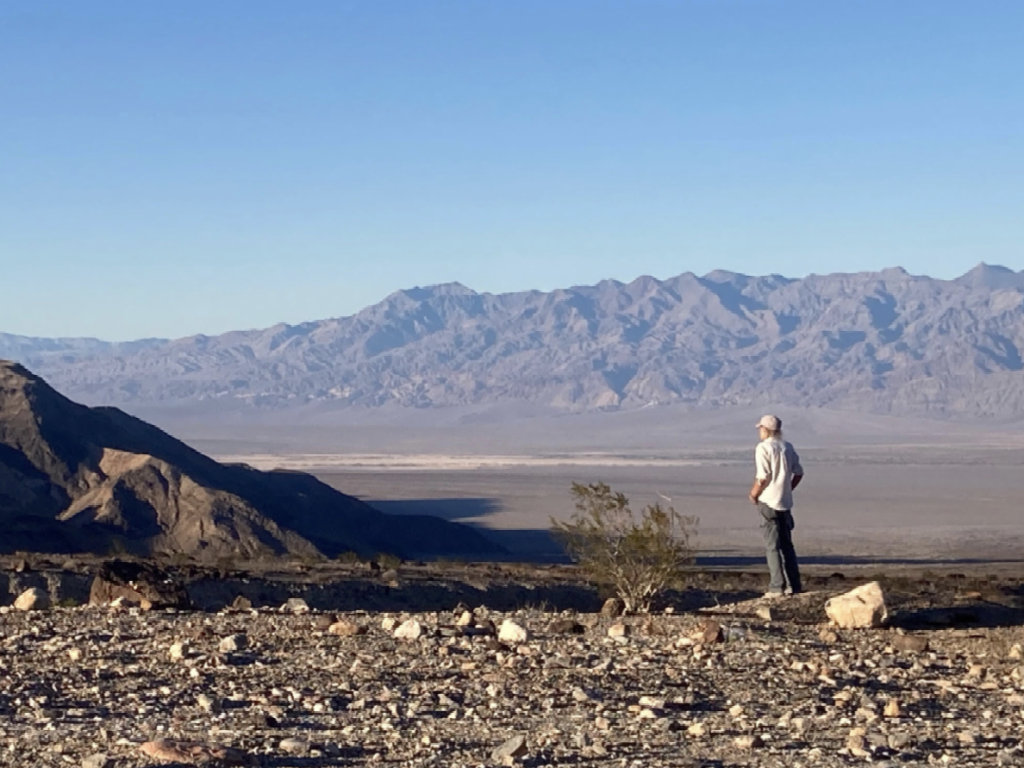
After a year of careful preparation, thirteen of us finally arrived in Death Valley for the Great Ballcourt Initiation Ceremony. Even before we sat in circle, there was a shared understanding that this Ballcourt carried a particular weight. It would be Meredith’s last time offering this ceremony before she stepped back from her life as a wilderness rites-of-passage guide.
Meredith’s stepping back isn’t a retreat, but rather a slow turning—like a season changing in its own time. Meredith has carried this work for more than fifty years, creating and tending it with Steven, her husband, and honoring the promise she felt to both him and her godmother, Ginny, whose knowledge of anthropology profoundly influenced the practice.
I recall the salience of Angelo’s words at the threshold circle as we honored Meredith: “You have fulfilled your commitment.” I saw the tears. Felt the gratitude. I do not believe there is one wilderness guide today that has not been touched, directly or indirectly, by Steven and Meredith’s work.
In 1980, as part of their exploration into new forms to help people deepen their relationship with life-affirming death, Steven and Meredith offered their first Ballcourt. When Steven died in 2003, the experience of walking with him through his dying further inspired Meredith, along with Scott Eberle, Steven’s hospice doctor, to bring the Practice of Living and Dying to the School of Lost Borders.
Now, being Meredith’s last formal offering, how perfect that the Ballcourt is about coming to terms with our dying so that life might continue on the other side of the cycle. It is this stark truth that is frequently forgotten in new-age ceremonies, which often emphasize building oneself up rather than letting go. But without looking at death squarely, without accepting the fact that we all die, something goes amiss, radically out of balance with nature, and the ego clutches onto its fictitious omnipotence. Climate chaos, environmental degradation, and human injustice are only a few extreme symptoms of turning away from the face of death.
One of our nights in Death Valley was met by a tremendous storm. We watched as the dark clouds cast their shadows on the distant Funeral Mountains. Meredith walked over to me in the kitchen and said, “I think the storm is coming toward us,” and I responded with my doubt. “Really? It looks so far away.” But she knew, and sure enough, we were soon in it, wind whipping, thick and thunderous lightning bolts making us howl in fear and excitement. We secured our tents, and most of the group piled into the vehicles for safety. The possibility of danger so quick upon us woke us up to something I can only name as mystery.
I have heard it said many times: a rite of passage is a dying practice, and grief is a powerful conduit for entering the portal of transformation. I have witnessed grief as the opening of the floodgates of the soul, water entering every cell of the body, swelling the limbs, organs, and mind to maximum capacity, weighing one down to earth. No doubt, for many, this is an excruciatingly painful process. It is for me. But it is also paradoxically redemptive when in right relationship with nature. It can even be beautiful, a desert primrose blooming at night only to wither the following morning.
In death’s company, nothing is taken for granted.
The traditional Mayan teachings that inspired the Ballcourt Ceremony have a lot to say about endings. They remind us: this is the way of nature; only through death can life regenerate itself.
Indeed, there are awful endings, but the cycle – birth, death, and rebirth – is ongoing. This cyclical perspective is so ancient and pre-colonized that, for me, it is nearly incomprehensible.
The idea of endless regeneration is pre-verbal, pre-binary, pre-intellectual. It gives me great comfort as well as a sense of gravitas to imagine that while my life will end, something of me – my essence, perhaps – will carry on.
In the Mayan sacred book, the Popol Vuh, we are instructed, through story, that every individual carries an essence at their core. This essence is not bound by the physical body, but manifests through our character and actions. * We know a person’s essence through their work, their expression of creativity, their devotions. Our essence is mysteriously passed down to us from our ancestors – biological and spiritual – and, like a precious gift, we will pass it on to those who come after.
And it takes work. The essence doesn’t automatically express itself. The Popol Vuh informs us that we must choose to live into our essence. If we don’t make the choice, the essence can be forgotten, lost, and buried in the unconscious. To keep the essence alive takes real work, ancestral remembering, and honest reflection.
Being with Meredith as she brings to a close a lifetime of guiding work, there is no mistaking the essence she embodies. It is manifest in the thousands of people she has touched, in the lineage of the School of Lost Borders, in the barebones simplicity of her teaching. As Meredith now steps away more deliberately, I know this means it is time to further turn our focus away from the person and toward our individual responsibility to manifest the essence that has so deeply touched us. To live it in our own unique way so that we can nurture and leave it in good condition for future generations. To consciously participate in, and thus continue, the endless cycle of birth, death, and rebirth. We do it for the children. We do it in service to the unfolding creation of life.
Betsy Perluss
Thanks to Alexus McLoed for his insightful essay Loss and Continuation from the Popol Vuh. Note: The Popol Vuh, or Popol Wuj in the K’iche’ language, is a text recounting the mythology and history of the K’iche’ people of Guatamala, one of the Mayan peoples who also inhabit the Mexican states of Chiapas, Campeche, Yucatan and Quintana Roo, as well as areas of Belize, Honduras, and El Salvador. It is a foundational sacred narrative from long before the Spanish conquest of the Maya. It can be translated to “Book of the Community” or “Book of Council.” The ballcourt, or ballgame, is described in the Popol Vuh and was integral to the Mayan culture. More can be read about it here.
Share This